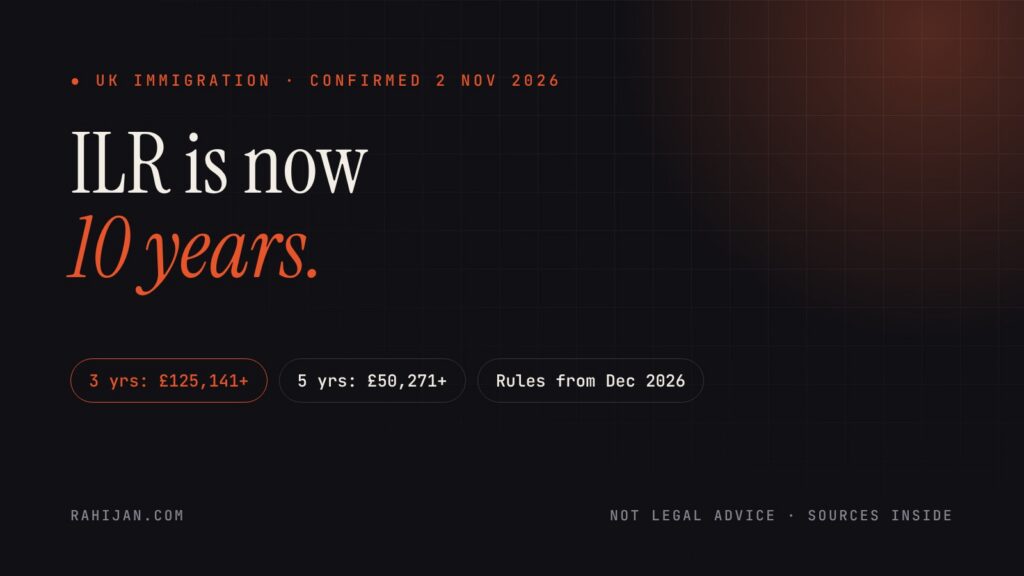
UK IMMIGRATION · 2 NOVEMBER 2026
The Government has now confirmed its new earned settlement rules for Indefinite Leave to Remain (ILR). On 2 November 2026 the Home Secretary set out the policy to Parliament and published the Government’s response to the consultation, A Fairer Pathway to Settlement (CP 1707). The headline: the standard wait for settlement goes up from 5 years to 10 years, with faster and slower routes depending on your circumstances.
Reporting checked on 2 November 2026, the day of the announcement. This is general information, not legal advice. The detailed Immigration Rules have not been published yet, so always check GOV.UK or speak to a regulated immigration adviser (OISC-registered or a solicitor) about your own case.
The short version
- Default: 10 years before you can apply for ILR, up from 5.
- Faster: 3 years if you earn £125,141 or more; 5 years if you earn £50,271 or more, or work in certain public service roles such as doctors, nurses and teachers.
- Unchanged: family of British citizens, BN(O) visa holders and armed forces keep their current 5-year routes.
- Slower: 20 years if you have claimed specified benefits in the 5 years before applying, or have committed immigration breaches as an adult.
- Who: it applies to people already in the UK who do not yet have ILR. If you already have ILR, it will not be taken away.
- When: the Home Secretary said the changes “will begin to be laid from the December Immigration Rules” and be implemented over 2027. So it is confirmed policy, but most of it is not law yet.
The new qualifying periods
- 3 years: income of at least £125,141 a year (in line with the additional rate of income tax), in 3 of the last 4 years. People on the top talent routes are also included.
- 5 years: income of at least £50,271 a year (in line with the higher rate of income tax), in 3 of the last 5 years.
- 5 years: doctors, nurses and teachers in national pay-scale roles listed in the Immigration Rules.
- 5 years: eligible partners, parents and children of British citizens, Commonwealth citizens with a UK-born grandparent, BN(O) visa holders and members of the armed forces.
- 10 years: everyone else (the new default).
- 20 years: applicants who have accessed specified public funds in the 5 years before applying, or who committed specified immigration breaches (such as overstaying, breaching conditions or deception) as an adult.
The income thresholds will move in line with the income tax thresholds. Couples can combine their incomes to meet the basic contribution test (£25,142 combined).
What everyone will need
These are minimum requirements. The response says they cannot be offset by higher earnings or public service.
- English at B2 level (upper-intermediate). C1 no longer gives a shorter wait.
- The Life in the UK test continues, with the existing exemptions.
- No criminal record in the UK. Any adult with a criminal record will be refused settlement, including suspended sentences, cautions, fines and community sentences.
- No debts to the Government, such as NHS charges, tax, National Insurance or Home Office litigation costs.
- A sustained contribution: earnings of at least £12,571 a year over a number of years. The response gives slightly different wording in different places, so watch for the final rules.
Children, people aged 65 or over, and those who cannot meet a requirement because of a physical or mental condition are exempt from the English and earnings tests.
Will it apply if I’m already in the UK?
Yes, in most cases. The Government says the rules are decided at the point you apply for settlement, not when you arrived. GOV.UK says anyone seeking settlement “regardless of when they arrived” will need to meet the new conditions. Settled status will not be removed from anyone who already holds it.
There are some transitional arrangements:
- Care workers who joined the route before the May 2025 Immigration White Paper, met their visa conditions and earned at least £25,000 a year can still settle after 5 years. Those who did not meet the conditions may get a new 5-year visa.
- Some public service workers below degree level (for example nursing auxiliaries and teaching assistants) who arrived before May 2025 also keep a 5-year route.
Time spent on temporary routes, such as Student or Graduate visas, will no longer count towards settlement, and the 10-year Long Residence route closes.
When does it start?
Not today. In her statement the Home Secretary said the changes “will begin to be laid from the December Immigration Rules” and “will be implemented over the course of 2027”. The Government also says it will publish further guidance before implementation. Until the new rules are laid and in force, the current rules still apply. Exact start dates for each part have not been published yet.
What you can do now
- Check your own dates under the current rules. If you can apply before the new rules take effect, speak to an adviser about timing.
- Keep evidence of your earnings: payslips, P60s and HMRC records.
- Clear any debts to the NHS, HMRC or Home Office.
- Work towards B2 English and pass the Life in the UK test.
- Avoid immigration breaches and watch your absences.
- Follow GOV.UK for the December Statement of Changes, and get regulated advice for your situation.
Watch the 1-minute version
I made a short video summary of this update. It is on my channels: @iamrahijan on Instagram, TikTok, YouTube, Facebook and X, and on LinkedIn.
Earlier background (before the announcement): UK ILR changes 2026: confirmed vs proposed.
Sources
Official
- GOV.UK: Home Secretary unveils new rules for migrants settling in the UK (2 November 2026)
- A Fairer Pathway to Settlement: Government Response to the Consultation (CP 1707, PDF)
- GOV.UK: Earned settlement consultation
- A Fairer Pathway to Settlement: original consultation (CP 1448, November 2025, PDF)
- GOV.UK: Life in the UK test
Reporting
- EIN: Home Secretary confirms major changes to indefinite leave to remain rules under ‘earned settlement’ reforms (2 November 2026, includes the Commons statement)
Disclaimer: this article is general information based on the Government’s announcement and consultation response of 2 November 2026. It is not legal advice. Details may change when the Immigration Rules are published.