Update, 2 November 2026: the Government has now confirmed the earned settlement rules. Read the latest: ILR is now 10 years: the new rules explained.
UK IMMIGRATION · 2 NOVEMBER 2026
Few topics are causing more worry in UK migrant communities right now than Indefinite Leave to Remain (ILR). Social media is full of claims that “ILR is now 10 years for everyone”. Some of that is true as a proposal, but it is not the law today. This guide separates what is confirmed from what is still only proposed, with official sources at the end.
Checked on 2 November 2026. This is general information, not legal advice. Rules can change quickly, so always check GOV.UK or speak to a regulated immigration adviser (OISC-registered or a solicitor) about your own case.
The short version
- Today: most work and family routes still lead to ILR after 5 years. The Long Residence route is 10 years.
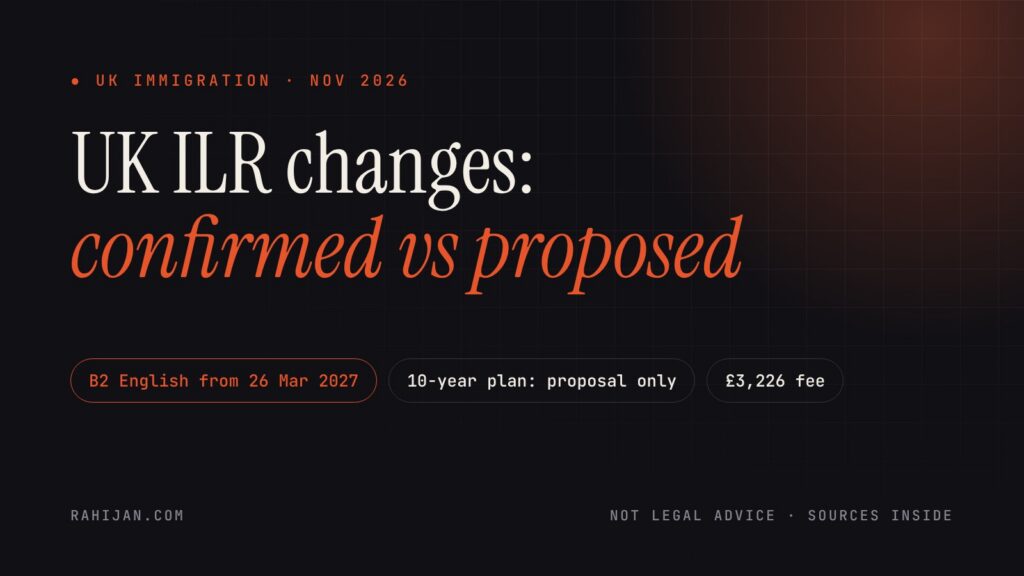
- Confirmed: for many routes, settlement applications made on or after 26 March 2027 will need English at B2 level instead of B1.
- Proposed only: a new “earned settlement” system with a 10-year baseline, which could be shorter or longer depending on your circumstances.
- Not decided: when it starts and exactly who is protected. As of 2 November 2026, no Immigration Rules bringing in the 10-year baseline have been laid, and no start date has been published.
What ILR requires right now
If you are on a 5-year route today (for example Skilled Worker, or as a partner of a British citizen), the usual requirements still apply:
- Qualifying residence: normally 5 continuous years on an eligible route.
- Absences: on most routes, being outside the UK for more than 180 days in any 12-month period can break your continuous residence.
- Life in the UK test: you must pass it. The test costs £50 and must be booked at least 3 days in advance.
- English language: currently B1 for most applicants (rising to B2 for many routes from 26 March 2027).
- Application fee: £3,226 per applicant since 8 April 2026 (previously £3,029).
What “earned settlement” proposes
On 20 November 2025 the Home Office published A Fairer Pathway to Settlement, a statement and consultation on “earned settlement”. The consultation closed on 12 February 2026. The core idea: the default wait for settlement would rise from 5 years to 10 years, and your own “contribution” would move that number up or down.
Proposed reductions (only the largest would apply)
- Taxable income of £50,270 or more for 3 years: 5 years off
- Taxable income of £125,140 or more for 3 years: 7 years off
- Working in specified public service roles for 5 years: 5 years off
- Community work or volunteering: 3 to 5 years off
- Partner, parent or child of a British citizen: 5 years off (so a 5-year route remains)
- BN(O) visa holders: 5 years off
- English at C1 level: 1 year off
Proposed increases
- Receiving public funds (benefits) for under 12 months: +5 years; over 12 months: +10 years
- Illegal entry, entry on a visit visa, or overstaying for 6 months or more: much longer waits, up to 20 years
- Skilled Workers in roles below degree level (RQF 6), including many care roles: the consultation floated a separate 15-year baseline
Proposed mandatory requirements
- English at B2 level
- Passing the Life in the UK test
- A clean criminal record (the document says you should not expect to settle with one)
- No outstanding NHS, tax, litigation or other government debts
- Earnings above about £12,570 a year for several years (still subject to consultation)
Will it apply to people already in the UK?
This is the biggest worry, and the honest answer is: the government wants it to, but it is not decided in law yet.
The consultation says the government proposes to apply the changes to everyone in the UK who has not already received ILR. It also asked whether there should be transitional arrangements for people already on a route to settlement. The Home Secretary has repeated this intention in speeches during 2026.
However, as of 2 November 2026:
- The government has not published its response to the consultation on GOV.UK.
- No Statement of Changes introducing the 10-year baseline has been laid. The 2026 Statements (including HC 1691 in March) did not bring it in.
- There is no confirmed start date. An “autumn 2026” target was reported, and several law firms now say this appears to have slipped.
- No transitional protection has been published.
People who already hold ILR, or settled status under the EU Settlement Scheme, are outside the scope of these proposals.
What you can sensibly do now
- Work out your own dates. Know exactly when you first become eligible under the current rules.
- Keep your records tidy. Payslips, P60s, tax records and travel history. Under a contribution-based system, evidence will matter even more.
- Watch your absences. Avoid long trips that could break continuous residence.
- Do the parts you control. Pass the Life in the UK test, and consider improving your English towards B2.
- Avoid unpaid government debts and anything that could raise suitability issues.
- Check the source, not the rumour. Follow the GOV.UK consultation page and the Immigration Rules. For your own situation, get advice from an OISC-registered adviser or an immigration solicitor.
Watch the 60-second version
I made a short video summary of this guide, and it is on my social channels: @iamrahijan on Instagram, TikTok, YouTube, Facebook, X and LinkedIn.
Sources
Official (GOV.UK)
- Earned settlement consultation page (Home Office): ran 20 November 2025 to 12 February 2026; outcome not yet published.
- A Fairer Pathway to Settlement: statement and consultation (accessible version)
- A Fairer Pathway to Settlement: command paper (PDF)
- Statement of changes to the Immigration Rules: HC 1691, 5 March 2026
- Life in the UK Test: book the test (£50)
Parliament
Legal commentary (checked October 2026)
- FSP Law: ILR changes 2026, where earned settlement stands now (updated 23 October 2026)
- OTS Solicitors: Earned settlement after Labour Conference 2026 (22 October 2026)
- UK Immigration Lawyers: Earned settlement, is it confirmed? (updated 24 September 2026)
- EIN: Home Secretary reaffirms earned settlement reforms will be retrospective (9 March 2026)
- Thorntons: Home Office fee increases from 8 April 2026 (ILR fee £3,226)
Disclaimer: this article is general information based on public sources checked on 2 November 2026. It is not legal advice and may become out of date when the government publishes new rules.