
Published 6 November 2026 · Last verified: 6 November 2026, 21:40 GMT (Europe/London); Friday market figures are US closing values. On Thursday 5 November, about $3 trillion was wiped off the value of S&P 500 companies in a single session, and chip stocks had their worst day since March 2020. The trigger was not a bad earnings report or a failed AI model. It was a vote. This explainer covers what happened, why investors suddenly worry about AI’s money and its permission to build, the evidence for and against a bubble, and what it means for ordinary people.
Summary
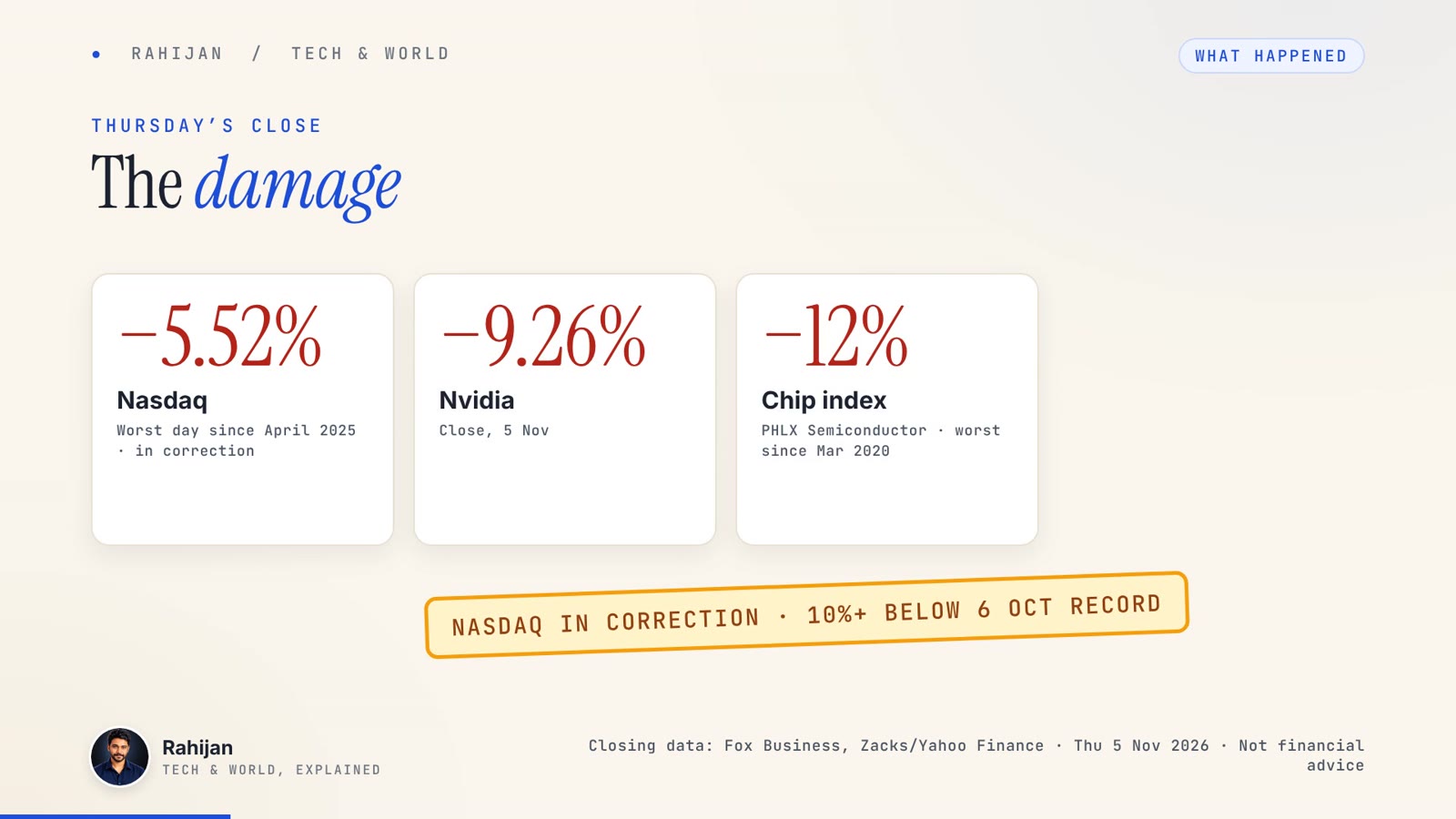
- What happened: after the 3 November US midterms, the Nasdaq fell 5.52% on 5 November, its worst day since April 2025, closing in correction territory. Nvidia fell 9.26% and the PHLX Semiconductor Index about 12%.
- The money: AI infrastructure spending is heading towards about $1 trillion a year. Some heavily borrowed players face a gap between their cost of borrowing and expected returns.
- The permission: voters sided against data centres in 40 of 41 local ballot measures, and new governors in Texas and Ohio back moratoriums or tighter rules.
- Is it a bubble? The evidence points both ways: plans far outnumber projects being built, but AI demand and revenue are growing fast.
- For you: pensions and index funds can feel the swings; OpenAI has pledged to pay its own electricity costs and stop using NDAs with officials.
What happened this week
US voters went to the polls on Tuesday 3 November, and Democrats won control of both the House and the Senate. Stocks rose on Wednesday as uncertainty cleared, Fox Business reports. Then, on Thursday 5 November, the mood flipped.
- Nasdaq Composite: down 5.52% to 24,315, its worst day since April 2025, and at least 10% below its 6 October record close, which puts it in correction territory.
- S&P 500: down 4.36%. Zacks and Yahoo Finance estimate about $3 trillion of market value was wiped from S&P 500 companies.
- Nvidia: down 9.26%. The PHLX Semiconductor Index fell about 12%, its worst day since March 2020 (Yahoo Finance).
- VIX: Wall Street’s “fear gauge” rose about 70% to 28.18 (Zacks).
On Friday 6 November, some of that bounced back. At the US close, the PHLX Semiconductor Index rose 4.21%, the Nasdaq 1.09% and the S&P 500 0.32%, while the Dow slipped 0.46% (Yahoo Finance closing data). Nvidia gained 2.78% and AMD 11.04%. It was still a rough week overall.
So this was not a straight-line collapse. It was a sharp repricing, driven by two linked worries: the money, and the permission.
Part 1: the money
AI models run in data centres: large buildings packed with chips, cooling systems and power equipment. They are extraordinarily expensive. A Columbia Business School economist, quoted by CNN, says AI infrastructure spending is heading towards roughly $1 trillion a year, which as a share of the US economy would outpace every modern US investment boom, including the railroads. ING economists estimate AI investment accounted for as much as a quarter of US economic growth this year.
The spending is straining balance sheets. CNBC reports that Alphabet, Amazon and Meta have each turned cash-flow negative while building, with Microsoft the exception. Smaller players are under more pressure: CNN reports that CoreWeave, which rents out computing capacity, saw its bond yields surge to around 15%, while its expected return on investment is around 9%. Borrowing at 15% to earn 9% only works if growth keeps arriving.
Interest rates are part of the picture too. The US Bureau of Labor Statistics reported 165,000 new jobs in October, far above forecasts, and Yahoo Finance reports that this keeps a possible Federal Reserve rate rise in December on the table. Higher rates make expensive, debt-funded building harder to justify.
Part 2: the permission
Every data centre needs land, a grid connection, often water, and approval from local officials. This week, voters made clear they want a say.
- Ballot measures: Ballotpedia counted 41 local data-centre measures in 10 states on 3 November. According to Ballotpedia and additional results gathered by CNBC, voters sided against data centres in all but one (Harwood, North Dakota).
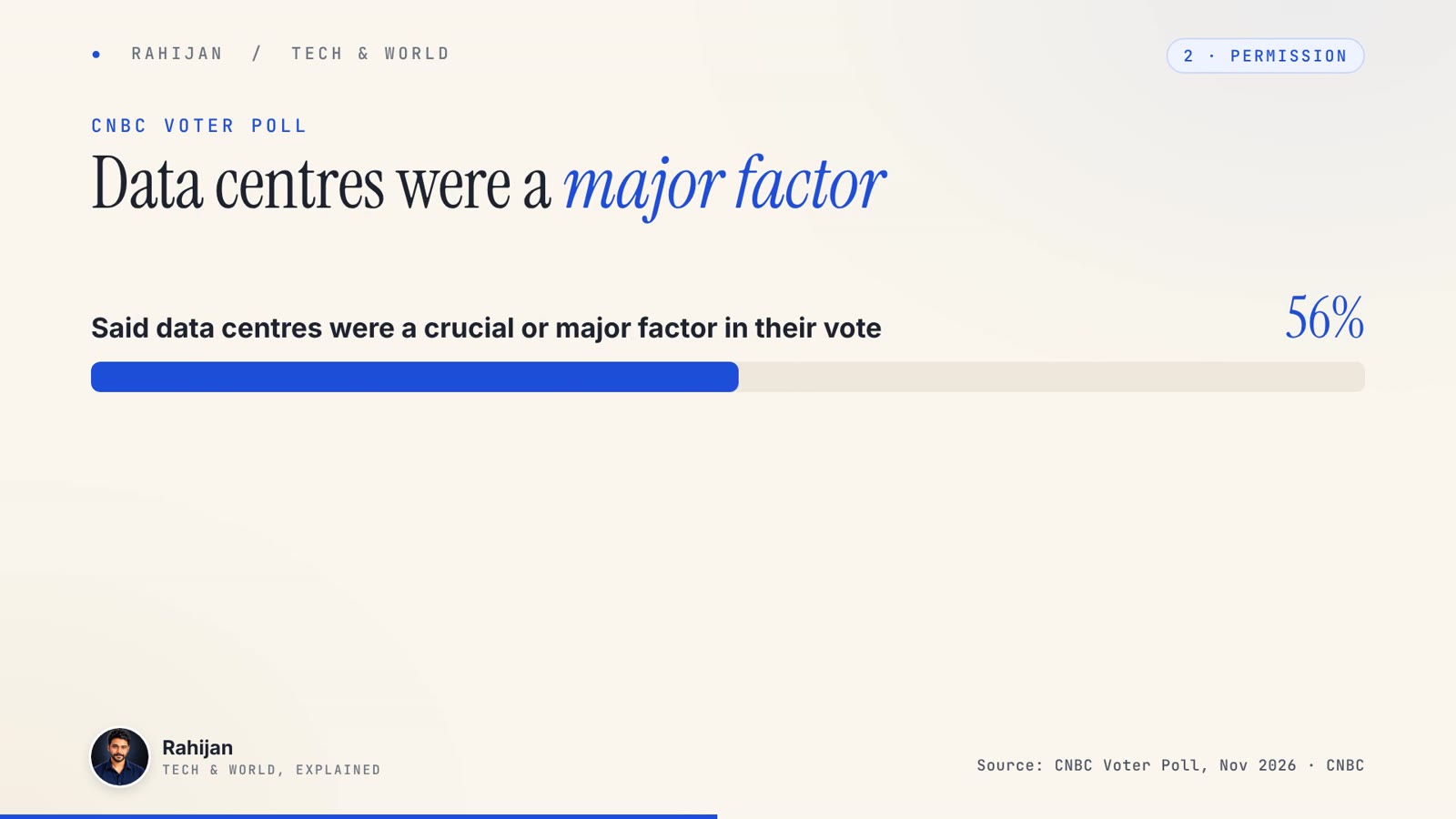
- Voter priorities: in a CNBC Voter Poll, 56% of voters said data centres were a crucial or major factor in their decision. CNBC reports worries about utility bills, environmental harm and jobs.
- Governors: in Texas, Democrat Gina Hinojosa unseated Governor Greg Abbott after campaigning on extending a data-centre moratorium (CNBC, CNN). In Ohio, Amy Acton, who defeated Vivek Ramaswamy, backs a “conditional moratorium”.
- Scale: Goldman Sachs estimates that from January, states led by Democrats who back moratoriums will hold about 45% of America’s planned data-centre capacity (via CNN). That is planned capacity, not cancelled projects.
That is why investors reacted so sharply. The concern is not that AI stopped working. It is that the buildings AI needs could become slower and more expensive to approve.
Part 3: so, is it a bubble?
The honest answer is that the evidence points both ways.
The worried side
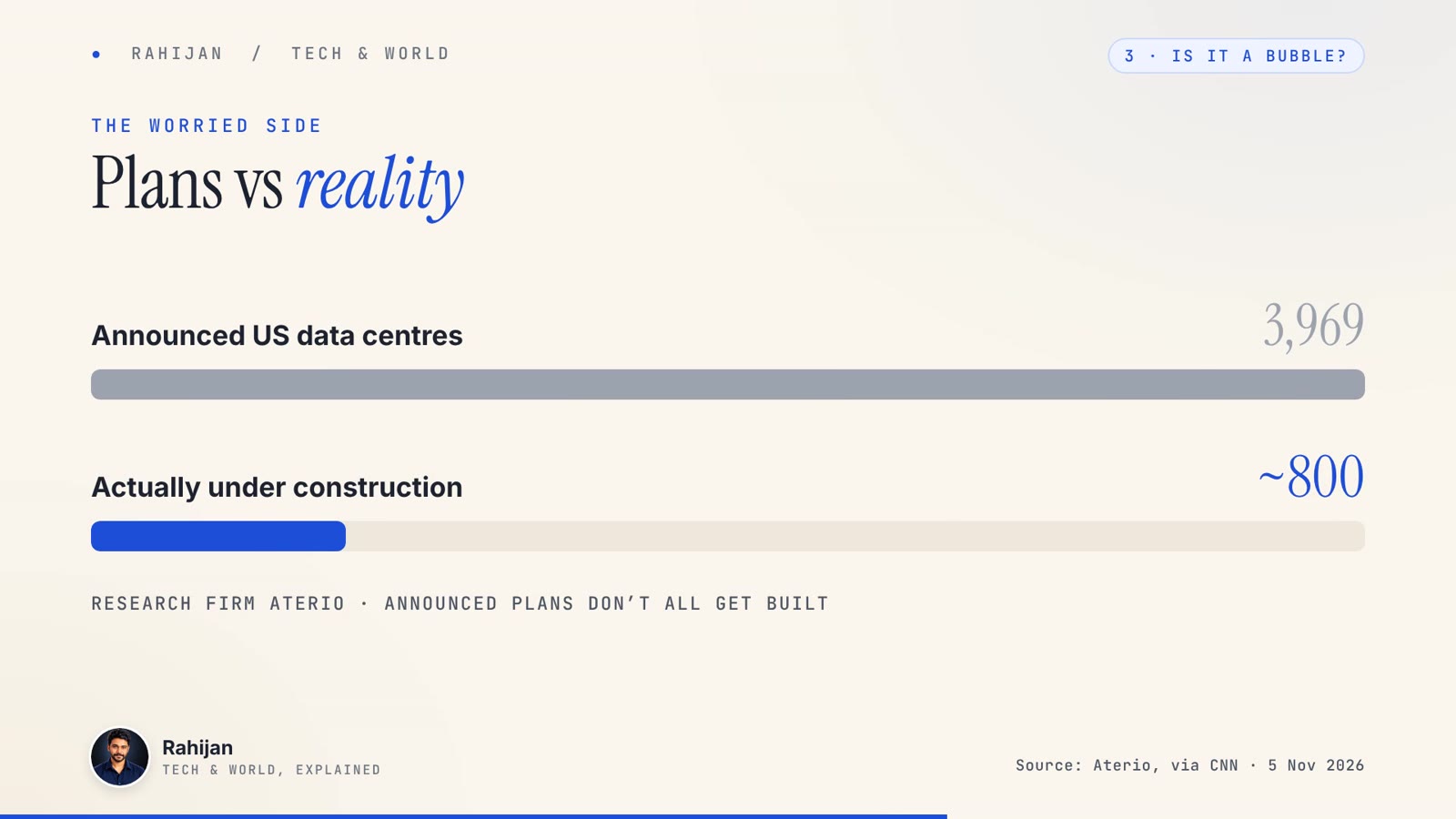
- Plans vs reality: the research firm Aterio counts 3,969 announced US data centres, but only about 800 under construction (via CNN).
- Valuations: Bloomberg and The Wall Street Journal report that investors now eye Anthropic’s planned IPO at a valuation of $1 trillion to $1.3 trillion, well below the roughly $2 trillion projected last month (via Yahoo Finance). These are reported expectations, not a final price.
The other side
- Demand: data-centre operator Iren reported $200 million of AI cloud revenue in the three months to 30 September, up from $71 million the previous quarter and $7 million a year earlier, although it still posted a quarterly loss (Yahoo Finance).
- Permits: Texas governor-elect Gina Hinojosa told CNN that already-permitted projects would be allowed to finish construction, according to Yardeni Research.
- Analysts: Yardeni Research described the political backlash as “speed bumps, not roadblocks” and called Thursday’s sell-off overdone.
A fair summary: this looks less like AI collapsing and more like markets pricing in a build-out that will be slower, more political and more expensive than expected.
Part 4: what it means for you
- Pensions and index funds: if your pension or fund tracks global or US shares, you probably own some of these companies, so sharp moves in AI stocks can show up in your statements. That is a reason to understand what you own, not to make decisions based on one week.
- Businesses: AI tools are not going away. But if new computing capacity is slower to arrive, the most advanced AI services could stay expensive for longer. (This is our assessment, not a forecast from the sources.)
- Communities: the balance of power is shifting. On 5 November, OpenAI published a National Community Compact and policy blueprint. For campuses it owns and operates, it says it will “pay the full cost of the electricity we use and the infrastructure needed to serve us”, publish site-level water and electricity use, and “not use non-disclosure agreements (NDAs) with public officials”. These are company pledges, not laws. The blueprint (PDF) asks lawmakers to make similar rules mandatory.
Markets move quickly. Nothing in this article is financial advice.
The takeaway
For years, AI’s biggest bottleneck was chips. This week suggests the next one is permission: the power, the land and the consent of the people who live next door. The companies that earn that trust will find it much easier to build.
What to watch next
- Whether chip and data-centre stocks stabilise next week, and whether the Nasdaq recovers from correction territory.
- The Federal Reserve’s December decision.
- New governors taking office in January, and any changes to state data-centre permits and tax incentives.
- More local votes: Clarksville, Arkansas (1 December) and Mandan, North Dakota (15 December), according to Ballotpedia.
- Anthropic’s IPO timing and pricing.
Editorial note: researched and verified on 6 November 2026 (21:40 GMT; Friday figures are US closing values). The video uses AI English narration, original animated graphics and quiet original music; no third-party footage is used, and illustrations are labelled. Related: our short explainer Voters said no to AI data centres. Then Wall Street fell and our 6 November news roundup.
References & Sources
- Fox Business: Stocks plunge as Dem midterm sweep fuels AI regulatory concerns (5 Nov 2026)
- Zacks via Yahoo Finance: Stock Market News for Nov 6, 2026
- Yahoo Finance live: stocks rebound after sell-off as US adds 165K jobs (6 Nov 2026)
- Yahoo Finance: PHLX Semiconductor Index (^SOX), closing data 6 Nov 2026; also Nasdaq Composite, S&P 500, Dow
- CNN: America got the anti-data-center wave it voted for. Here come the economic consequences (5 Nov 2026)
- CNBC: Voters rebuff data centers in every ballot measure except one (4 Nov 2026)
- Ballotpedia News: Voters in ten states will vote on data center-related ballot measures (3 Nov 2026)
- CNBC: OpenAI releases new data center policy proposal after election rebuke (5 Nov 2026)
- OpenAI: Setting a new standard for responsible AI infrastructure (5 Nov 2026)
- OpenAI: Compute Campus Policy Blueprint (PDF)
- US Bureau of Labor Statistics: The Employment Situation, October 2026 (6 Nov 2026)
- CNBC: U.S. economy added 165,000 jobs in October (6 Nov 2026)