Published 7 November 2026 · Research cutoff: 7 November 2026, 16:30 GMT (Europe/London). On Sunday 1 November, more than $100 million started leaving a handful of crypto exchange accounts. By Wednesday, the owner of that money had confirmed it was the victim of a cyberattack. It wasn’t a crypto trader or an exchange. It was Crédit Mutuel Arkéa, a French cooperative bank. This explainer walks through what happened, how the attackers got in, what is confirmed, what is still unknown, and why it matters for ordinary bank customers.
Summary
- What happened: attackers reached Crédit Mutuel Arkéa through the platform of one of the bank’s service providers, then used the bank’s own account to send money to other banks, from where it may have been converted into crypto (Arkéa, 4 November).
- How much: the bank will only confirm the “order of magnitude” of a reported €118 million ($133 million). The president of the Crédit Mutuel confederation said the sum was more than €100 million and that part of it has already been recovered (AFP, 6 November).
- Customers: the bank says customer accounts were not used and customers’ money is unaffected, although some transfers were delayed.
- The crypto trail: an on-chain investigator, ZachXBT, flagged the withdrawals before the bank spoke and argues the delay let more than $30 million be laundered. According to Bitquery, about $63 million in stablecoins was swapped into ether within roughly four hours.
- Still unknown: the exact amount, which provider was involved, how the attackers got in, and who they are.
Who is Crédit Mutuel Arkéa?
Crédit Mutuel Arkéa is a cooperative banking group headquartered in Brittany, in western France. It brings together the Crédit Mutuel de Bretagne and Crédit Mutuel du Sud-Ouest federations and about 40 subsidiaries, including the online bank Fortuneo. BleepingComputer reports that it has more than 5.8 million members and €211.5 billion in assets.
The timeline
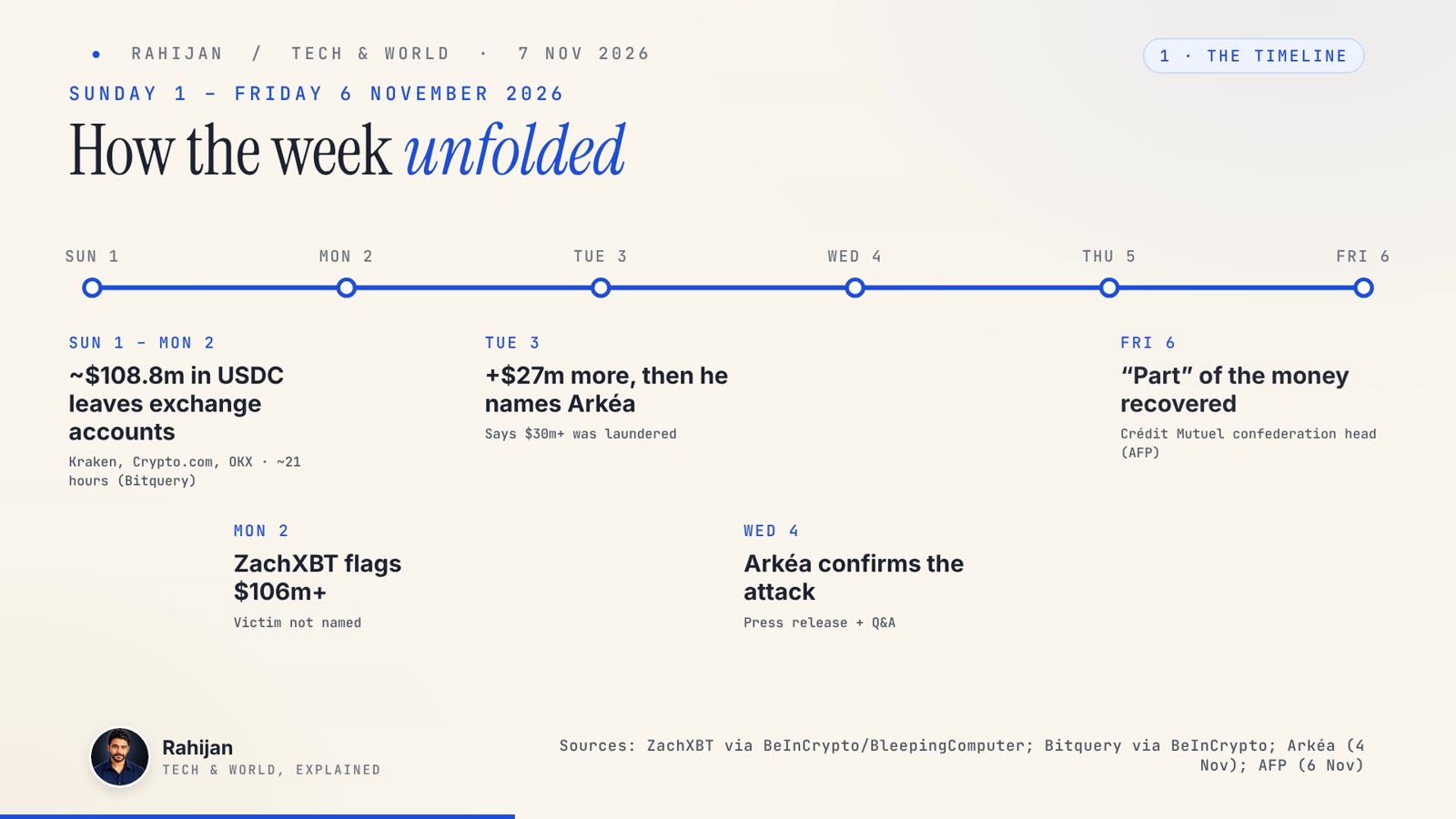
- Sunday 1 – Monday 2 November: Bitquery traced about $108.8 million in USDC leaving accounts at Kraken, Crypto.com and OKX over roughly 21 hours (via BeInCrypto).
- Monday 2 November: ZachXBT warned that an unnamed European institution had lost more than $106 million from several centralised exchange accounts, withdrawn as the stablecoins USDC and USDT.
- Tuesday 3 November: he reported a further $27 million in withdrawals, some after his first warning, and named Crédit Mutuel Arkéa as the alleged victim.
- Wednesday 4 November: Arkéa published a press release at 13:00 confirming an attack, followed by a question-and-answer statement.
- Friday 6 November: Daniel Baal, president of the Confédération Nationale du Crédit Mutuel, said on France 5 that Arkéa had “already” recovered part of the money. The investigation has been handed to France’s anti-cybercrime office (OFAC), AFP reported.
How the attackers got in
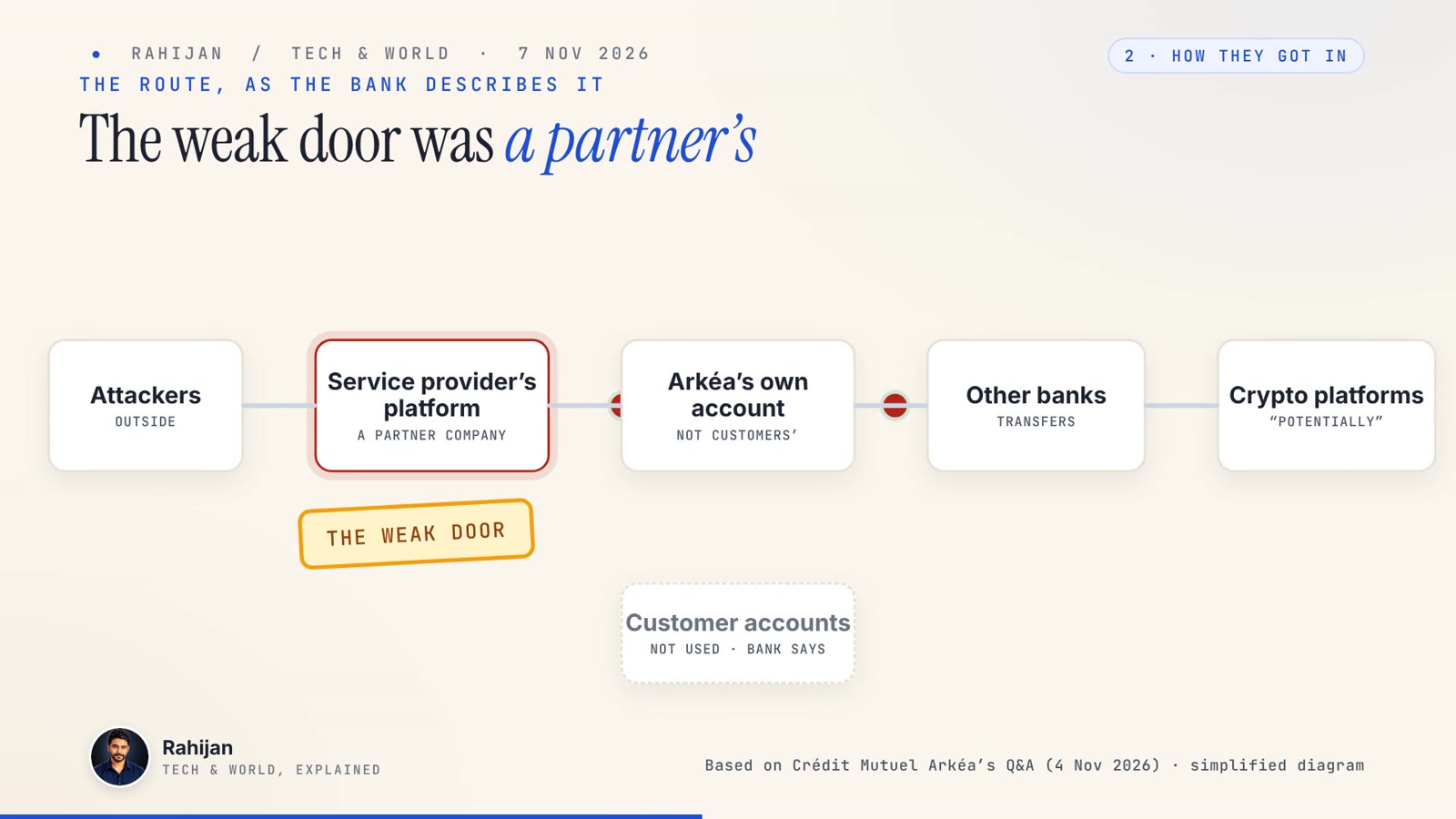
In its own Q&A, the bank says the attackers did not go through customers’ accounts or through Fortuneo. Instead, “les attaquants sont passés par la plateforme d’un de nos prestataires et ont ainsi atteint le Crédit Mutuel Arkéa directement” – the attackers went through the platform of one of its service providers and reached the bank directly. They then used Arkéa’s own account to send money to other banks, which, the bank says, may have allowed them to convert it into cryptocurrency on specialised platforms.
That is the heart of this story. A modern bank is connected to many outside companies that provide software, payments and data services. Each connection has to be trusted. Here, according to the bank, the weak point was a partner’s platform rather than the bank’s own front door. The bank has not named the provider or explained how the attackers gained access.
Arkéa says this was not human error inside the bank but “a sophisticated attack from outside”, that its systems identified the suspicious activity very quickly, and that it temporarily suspended some transactions as a precaution. It says it informed its supervisors and is working with the police and judicial authorities.
Why the crypto part matters
Stablecoins such as USDC and Tether’s USDT are digital dollars issued by companies. Those issuers can freeze tokens linked to crime, which makes stablecoins a real safety net for victims of theft, but only if someone acts quickly. Ether has no central issuer that can freeze it in the same way.
According to Bitquery, about $62.98 million of the stablecoins became 27,553 ETH within roughly four hours (via BeInCrypto). ZachXBT’s view is blunt: “No proper incident disclosure has resulted in $30M+ being laundered away which could have been frozen by EU law enforcement.” That is his claim; the bank has not commented on it.
What is confirmed, and what isn’t
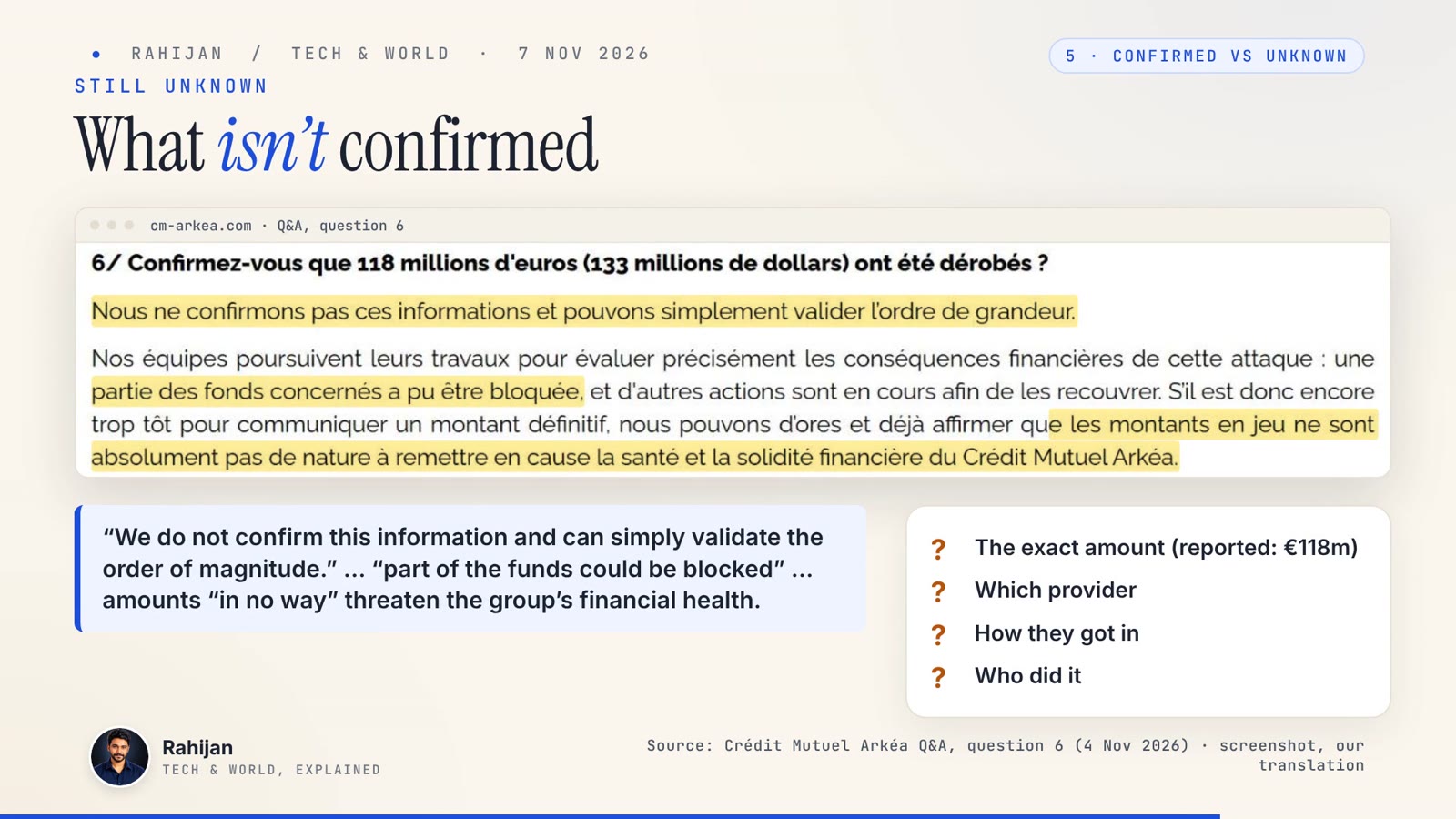
Confirmed: there was an attack; it came through a service provider’s platform; the bank says customers’ money is unaffected; part of the funds was blocked, and the head of the Crédit Mutuel confederation says part has been recovered. The bank also says the amounts involved do not threaten its financial health.
Not confirmed: the exact amount (the bank says “we do not confirm this information and can simply validate the order of magnitude” of the reported €118 million), which provider was involved, how the attackers got in, and who they are. Daniel Baal said he could not say whether the attack came from France or abroad.
What happens next
The police investigation continues and the bank says it is still assessing the final cost. One thing works in investigators’ favour: on a public blockchain, every movement of the funds leaves a trail that anyone can follow. That is how an outsider spotted this incident before the bank said anything publicly.
Two lessons for the rest of us
- Your bank is only as strong as the companies it plugs into. Third-party and supply-chain risk is now one of the main ways into well-defended organisations.
- Big incidents bring phishing. Arkéa itself warned customers to be vigilant. If you get an unexpected call, text or email about your bank account, don’t share details. Hang up and contact your bank yourself using a number you already trust.
Editorial note: researched and verified on 7 November 2026 (cutoff 16:30 GMT). Figures from ZachXBT and Bitquery are their own estimates as reported by BeInCrypto and BleepingComputer, not confirmed by the bank. French quotations are our translations. The video uses AI English narration and original animated graphics; the document excerpts are screenshots of the bank’s public Q&A. This is not financial advice.
References & Sources
- Crédit Mutuel Arkéa: Informations complémentaires suite à l’attaque dont le Crédit Mutuel Arkéa a été victime (Q&A, 4 Nov 2026)
- Crédit Mutuel Arkéa: Crédit Mutuel Arkéa annonce avoir été victime d’une attaque (press release, 4 Nov 2026)
- Crédit Mutuel Arkéa: press release (PDF, 4 Nov 2026)
- BleepingComputer: Hackers pull off $133 million French bank heist via service provider (7 Nov 2026)
- AFP via Yahoo Finance France: Crédit Mutuel Arkéa a récupéré “une partie” des 100 millions d’euros dérobés (6 Nov 2026)
- BeInCrypto: ZachXBT tracked a $133M crypto theft for two days. Then he named the victim
- The Block: French bank Crédit Mutuel Arkéa exploited for over $133 million, ZachXBT says (3 Nov 2026)
- Boursier via Bourse Direct: Crédit Mutuel Arkéa fait un nouveau point sur la cyberattaque (4 Nov 2026)
- Presse-citron: Fraude chez Crédit Mutuel Arkéa : la banque en dit plus (5 Nov 2026)