Published 6 November 2026 · Last verified: 09:30 GMT, 6 November 2026. On 3 November, American voters were asked about AI data centres in dozens of local ballot measures, and they said no almost everywhere. Two days later, AI and chip stocks had one of their worst days in more than a year. This article explains what happened, what is confirmed, and why it matters for the AI boom.
Summary
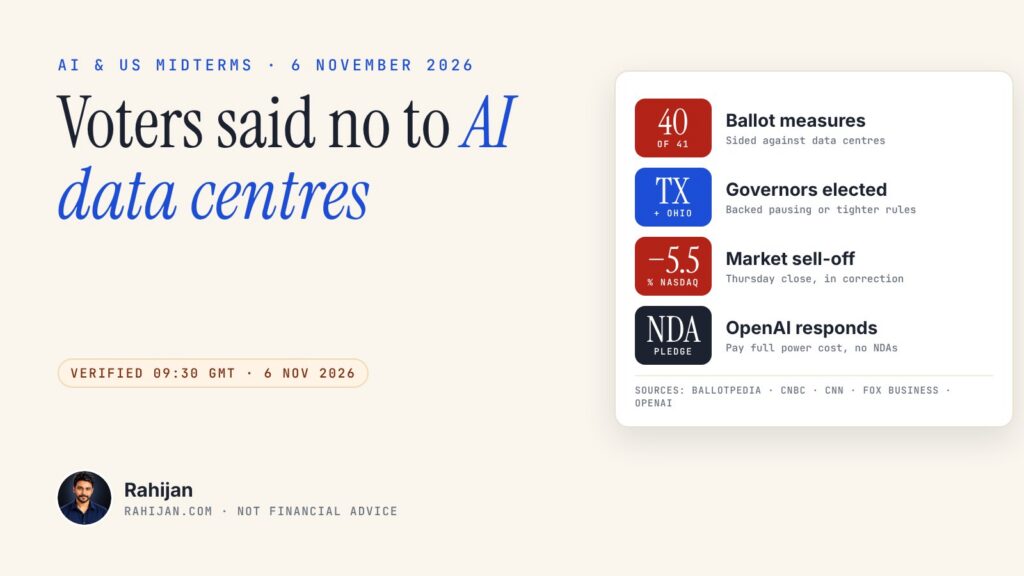
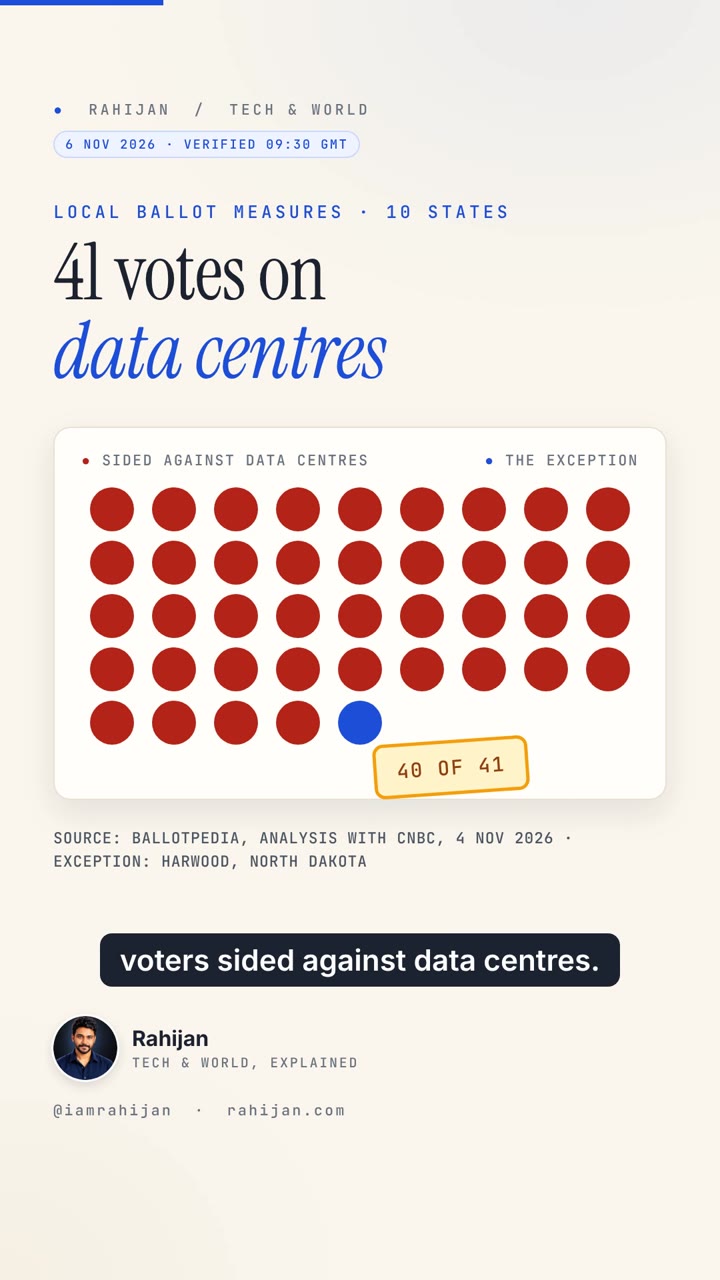
- Ballot measures: 41 local measures on data centres were on the ballot in 10 US states. Voters sided against data centres in every one except Harwood, North Dakota, according to Ballotpedia and additional results gathered by CNBC.
- Governors: in Texas and Ohio, Democratic candidates who campaigned on pausing or tightening data-centre rules won the governor’s races.
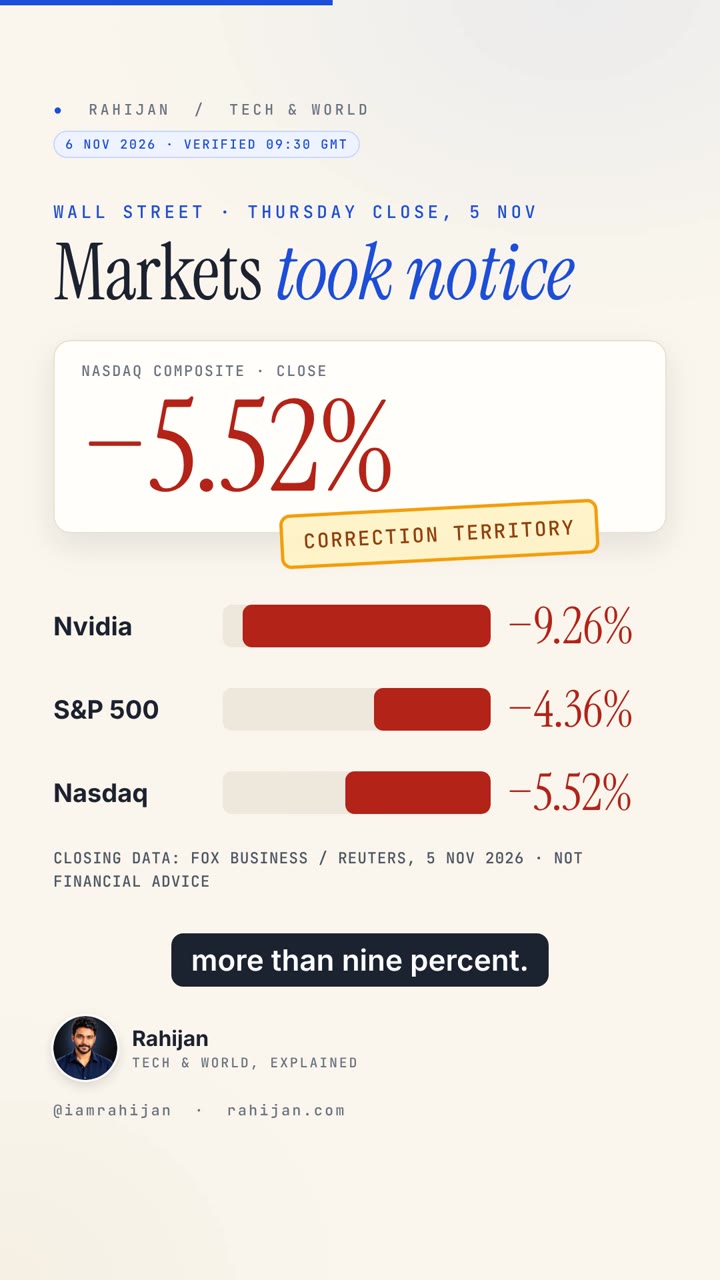
- Markets: on Thursday 5 November the Nasdaq Composite closed 5.52% lower, in correction territory, and Nvidia fell 9.26%.
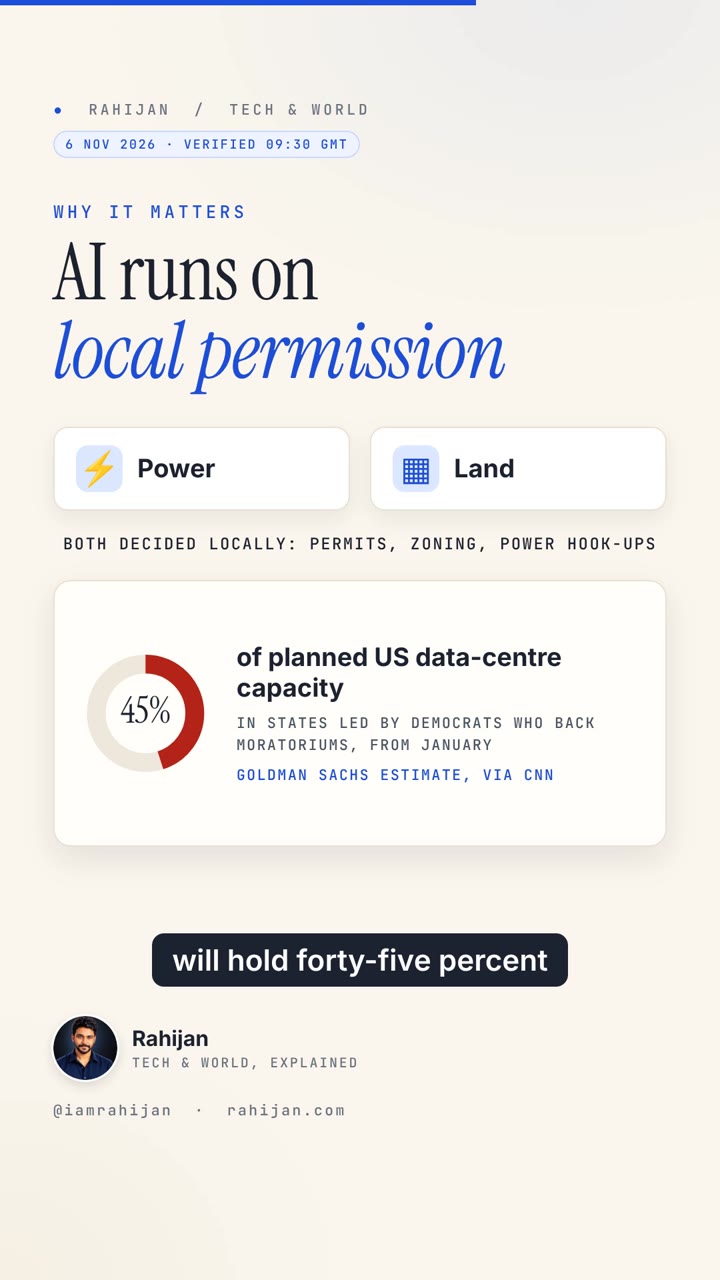
- Why it matters: Goldman Sachs estimates that, from January, states led by Democrats who back data-centre moratoriums will hold 45% of America’s planned data-centre capacity (as reported by CNN).
- Industry response: OpenAI published new commitments on 5 November, including paying the full cost of the electricity its campuses use and not using NDAs with public officials.
What happened at the ballot box
Ballotpedia, which tracks US ballot measures, counted 41 local measures on data-centre policy in 10 states on 3 November. A “yes” vote on 28 of them would have limited data-centre development, through bans, moratoriums or new requirements. A “yes” vote on the other 13 would have helped development, for example through rezoning. Ohio had the most, with 21 measures, followed by Illinois with seven.
According to Ballotpedia’s analysis and additional results gathered by CNBC, voters sided against data centres in every measure except one. The exception was Harwood, North Dakota, where voters rejected an added review of large industrial projects, including data centres.
This was not a one-off. Earlier in 2026, voters had already decided six data-centre measures in four states, and each time the majority favoured more limits. In July, New York Governor Kathy Hochul issued the first state-level moratorium, a one-year pause on permits for new data centres using 50 megawatts or more.
Data centres reached the governor’s races too
The issue also shaped bigger contests. In Texas, Democrat Gina Hinojosa unseated Governor Greg Abbott after blaming him for the rapid build-out of data centres across the state, CNBC reports. CNN notes that Abbott had already imposed a data-centre moratorium, which Hinojosa campaigned on extending until stronger AI rules are in place.
In Ohio, Democrat Amy Acton defeated Republican Vivek Ramaswamy. CNBC reports that Acton supports a “conditional moratorium” on data centres, so that they cover 100% of their utility costs and build with union labour. In a CNBC Voter Poll, 56% of voters said data centres were a crucial or major factor in their decision.
How Wall Street reacted
Stocks rose on Wednesday as election uncertainty cleared, then fell sharply on Thursday 5 November. At the close, according to Fox Business market data:
- Nasdaq Composite: down 5.52% to 24,315, its worst day since April 2025, and at least 10% below its 6 October record, which puts it in correction territory.
- S&P 500: down 4.36% to 7,353.73.
- Dow Jones Industrial Average: down 1,833 points, or 3.44%.
- Nvidia: down 9.26%. The Philadelphia Semiconductor Index fell more than 12%, and data-centre operators IREN, Applied Digital and Nebius each fell more than 14%.
Analysts quoted by Fox Business and Reuters linked the sell-off to expectations that new limits could make the AI build-out slower and more expensive. Other reasons are also in play, including high borrowing costs and existing doubts about whether AI spending will pay off, so the election is one factor rather than the only one.
Why it matters
AI models run in data centres, and data centres need huge amounts of electricity, land and often water. Permits, zoning, tax incentives and power connections are largely decided by states and local governments, which gives local voters real influence over the AI build-out.
CNN’s analysis puts numbers on that influence:
- Goldman Sachs estimates that, from January, states controlled by Democrats who support expanding or extending moratoriums will account for 45% of America’s planned data-centre capacity.
- Texas alone is set to host about a quarter of the planned US AI infrastructure build-out. Wells Fargo estimates that every 10% cut in planned Texas capacity would reduce Big Tech’s AI infrastructure spending by 1.6%.
- Aterio, a data-centre research company, counts 3,969 announced US data-centre projects, but only about 800 are under construction.
That does not mean half of America’s planned data centres are now cancelled. Demand for AI remains strong, the federal government supports the build-out, and governors cannot stop every project. But the pace and cost of building could change, and investors are adjusting for that.
How OpenAI responded
On 5 November, OpenAI published a National Community Compact and a Compute Campus Policy Blueprint. For future campuses that OpenAI owns and operates, the company says it will:
- pay “the full cost of the electricity we use and the infrastructure needed to serve us”, with financial assurances if a project is delayed or cancelled;
- publish site-level water and electricity use, construction plans and independent noise studies;
- not use non-disclosure agreements (NDAs) with public officials, apart from narrow protections for security information and trade secrets;
- publish expected jobs and report annually on local hiring.
The policy blueprint (PDF) asks lawmakers to turn similar commitments into rules, including requiring large electricity users to cover the grid costs they add. These are company pledges and proposals, not laws.
What is confirmed, and what isn’t
- Confirmed: the number of measures and their direction (Ballotpedia, CNBC), the governor results as reported, closing market figures, and OpenAI’s published commitments.
- Estimates: the 45% capacity figure (Goldman Sachs) and the Texas spending sensitivity (Wells Fargo) are analyst estimates, reported by CNN.
- Interpretation: how much of Thursday’s sell-off was caused by the election is a judgement made by analysts, not a measured fact.
What to watch next
- New governors take office in January, and the new Congress returns in late January.
- More local votes: Clarksville, Arkansas, on 1 December, and Mandan, North Dakota, on 15 December, according to Ballotpedia.
- Whether other AI companies follow OpenAI with public, enforceable community commitments.
- Whether chip and data-centre stocks stabilise, or whether investors keep cutting their growth expectations.
The takeaway
For years, the main limit on AI growth was chips. This week suggests the next limit may be permission: the power, land and local support that every data centre needs. Companies that earn community trust may find it easier to build.
Editorial note: researched and verified on 6 November 2026, 09:30 GMT. The video uses original animated graphics, AI English narration and quiet original music. Election results are as reported by the outlets cited. Nothing here is financial advice.
References & Sources
- Ballotpedia News: Voters in ten states will vote on data center-related ballot measures (3 Nov 2026)
- CNBC: Voters rebuff data centers in every ballot measure except one (4 Nov 2026)
- CNN: America got the anti-data-center wave it voted for. Here come the economic consequences (5 Nov 2026)
- Fox Business: Stocks plunge as Dem midterm sweep fuels AI regulatory concerns (5 Nov 2026)
- The Motley Fool via Yahoo Finance: Nasdaq suffers worst day in 18 months as AI trade comes under fire (5 Nov 2026)
- OpenAI: Setting a new standard for responsible AI infrastructure (5 Nov 2026)
- OpenAI: AI Infrastructure That Works for America, Compute Campus Policy Blueprint (PDF)
- CNBC: OpenAI releases new data center policy proposal after election rebuke (5 Nov 2026)