UK IMMIGRATION · 4 NOVEMBER 2026
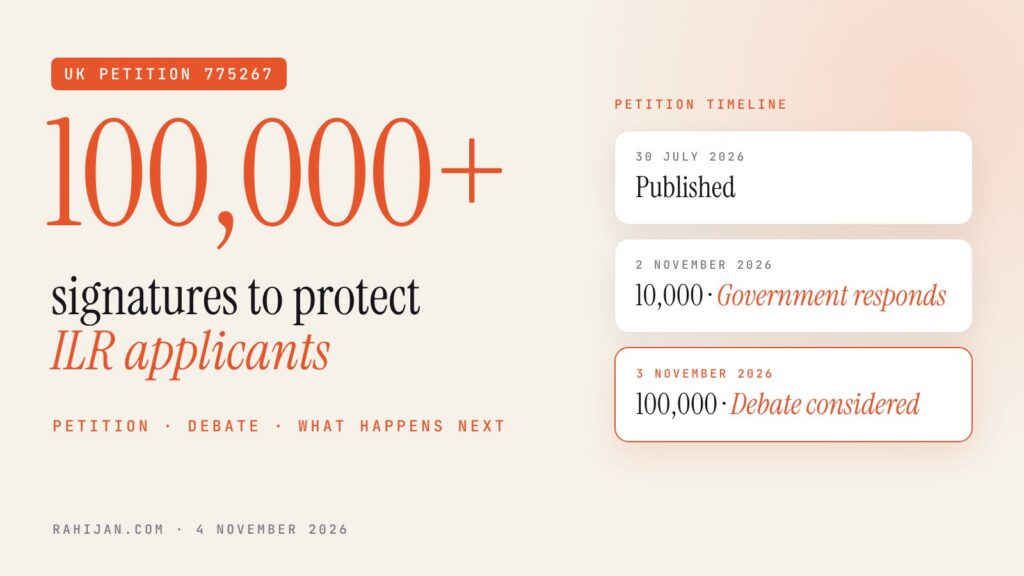
A UK Parliament petition asking the Government not to apply its new settlement rules to people already living here has passed 100,000 signatures. Petition 775267, “Legislate to protect ILR applicants from retrospective changes”, went from 10,000 to 100,000 signatures in less than 24 hours, straight after the Government confirmed that Indefinite Leave to Remain (ILR) will take 10 years for most people. This is what the petition asks for, why it grew so fast, and what a Parliament debate can and cannot do.
Figures checked on the official petition website on the morning of 4 November 2026. This is general information, not legal advice. For your own case, check GOV.UK or speak to a regulated immigration adviser (OISC-registered or a solicitor).
The short version
- The petition: “Legislate to protect ILR applicants from retrospective changes”, created by Justin Manjaly and published on 30 July 2026.
- What it asks: keep the 5-year ILR route for people already in the UK, and apply new settlement rules only to new arrivals.
- The trade-off it offers: signers would accept waiting up to 10 years for access to public funds, as a House of Lords committee suggested, if the 5-year ILR route is kept.
- Milestones: 10,000 signatures on 2 November 2026 and 100,000 on 3 November 2026. It had 111,879 signatures on the morning of 4 November.
- What happens next: the Government will publish a written response, and the Petitions Committee will consider it for a debate in Parliament.
- Deadline: the petition stays open until 30 January 2027.
What the petition says
The petition’s main request is short: “Keep the 5-year ILR route for people already in the UK and do not apply new settlement rules retrospectively. Future changes should apply only to new arrivals.”
Its supporting text sums up the argument as “Don’t move the goalposts for those already here”. It says people already living lawfully in the UK should stay eligible for ILR after 5 years under the rules that applied when they arrived.
It also offers a compromise. If the Government wants to restrict benefits, the petition says signers support waiting up to 10 years for access to public funds, “as proposed by the Justice and Home Affairs Committee”, while keeping the existing 5-year ILR route.
Why it grew so fast
The petition opened on 30 July 2026 and grew slowly for three months. The official data shows it reached 10,000 signatures late on 2 November 2026, and 100,000 late on 3 November 2026, less than 24 hours later.
The timing is not a coincidence. On 2 November, the Home Secretary set out the Government’s final earned settlement plan and published its response to the consultation A Fairer Pathway to Settlement. The key points:
- The standard wait for ILR rises from 5 years to 10 years.
- Some people can settle sooner: 3 years with income of £125,141 or more, and 5 years with income of £50,271 or more or in certain public service roles such as doctors, nurses and teachers.
- Family of British citizens, BN(O) visa holders and members of the armed forces keep 5-year routes.
- The new rules will apply to people already in the UK who do not yet have ILR. People who already have ILR keep it.
- The changes “will begin to be laid from the December Immigration Rules” and roll out over 2027.
For many Skilled Worker and Health and Care Worker visa holders, that confirmed the outcome they feared most: the finish line moving after they had already started the journey. You can read the full breakdown in my guide: ILR now 10 years: earned settlement rules confirmed.
Where the “10 years for public funds” idea comes from
The petition’s compromise comes from the House of Lords Justice and Home Affairs Committee. In a report published on 23 June 2026, the committee opposed raising the standard qualifying period for settlement to 10 years. It said the Government should instead explore keeping the 5-year baseline but with a longer period without access to public funds, for example 10 years or until citizenship.
The same committee said any retrospective change to settlement rules would be “manifestly unfair” to migrants who had planned their lives around the current rules, and could be unlawful. It recommended that changes should not apply to people already on a qualifying route. The Government’s 2 November plan did not follow that recommendation in full. It did keep 5-year routes for some groups, such as care workers who arrived before the May 2025 Immigration White Paper.
What 10,000 and 100,000 signatures mean
Petitions on the UK Parliament website have two thresholds:
- 10,000 signatures: the Government will respond in writing. The response is published on the petition page.
- 100,000 signatures: the petition will be considered for a debate in Parliament. The cross-party Petitions Committee decides whether to schedule a debate, and it can group similar petitions into one debate.
On the morning of 4 November 2026, the petition page showed no Government response and no debate date yet.
What a Parliament debate can and cannot do
Petition debates usually take place in Westminster Hall. MPs speak, and a Government minister replies. It is a useful way to put the issue on the record, but a petition debate does not end in a vote that changes the law, and it does not force the Government to change course.
This has happened before. On 2 February 2026, MPs debated two earlier ILR petitions that had each passed 100,000 signatures. Every backbench MP who spoke opposed applying the changes to people already here. The immigration minister replied that the Government would go ahead with earned settlement, and that transitional arrangements were still being consulted on.
What a debate can do is add pressure while the detailed Immigration Rules are still being written. The Government says the changes will be laid from December, so the transitional arrangements for people already in the UK are still the part most open to change.
What this means for Skilled Worker and other visa holders
- Nothing changes today. The current rules apply until the new Immigration Rules are laid and come into force. Exact start dates have not been published.
- A petition is not a guarantee. Even a large one does not change the law by itself.
- Watch the December Statement of Changes. It will show the actual rules and any transitional arrangements.
- Check your own dates. If you can apply for ILR under the current rules before the changes take effect, get regulated advice about timing.
- Keep your records in order: payslips, P60s and HMRC records, and clear any NHS, tax or Home Office debts.
Watch the 1-minute version
I made a short video on this petition. It is on my channels: @iamrahijan on Instagram, TikTok, YouTube, Facebook and X, and on LinkedIn.
References & Sources
Official
- UK Parliament petition 775267: Legislate to protect ILR applicants from retrospective changes (petition text, milestones and signature count)
- Petition 775267 official data (JSON)
- GOV.UK: Home Secretary unveils new rules for migrants settling in the UK (2 November 2026)
- GOV.UK: Earned settlement consultation
- House of Commons Library: E-petitions relating to indefinite leave to remain
- Petitions Committee: MPs will debate two petitions relating to indefinite leave to remain
Reporting and analysis
- Lewis Silkin: Justice and Home Affairs Committee publishes report on settlement, citizenship and integration (23 June 2026)
- EIN: ILR ‘earned settlement’ changes to proceed, says immigration minister, but transitional arrangements under review (2 February 2026)
- EIN: Home Secretary confirms major changes to indefinite leave to remain rules under ‘earned settlement’ reforms (2 November 2026)
Disclaimer: this article is general information based on the official petition page and published Government and Parliament sources as of 4 November 2026. It is not legal advice. Signature numbers change in real time.