SECURITY EXPLAINED · 31 OCTOBER 2026
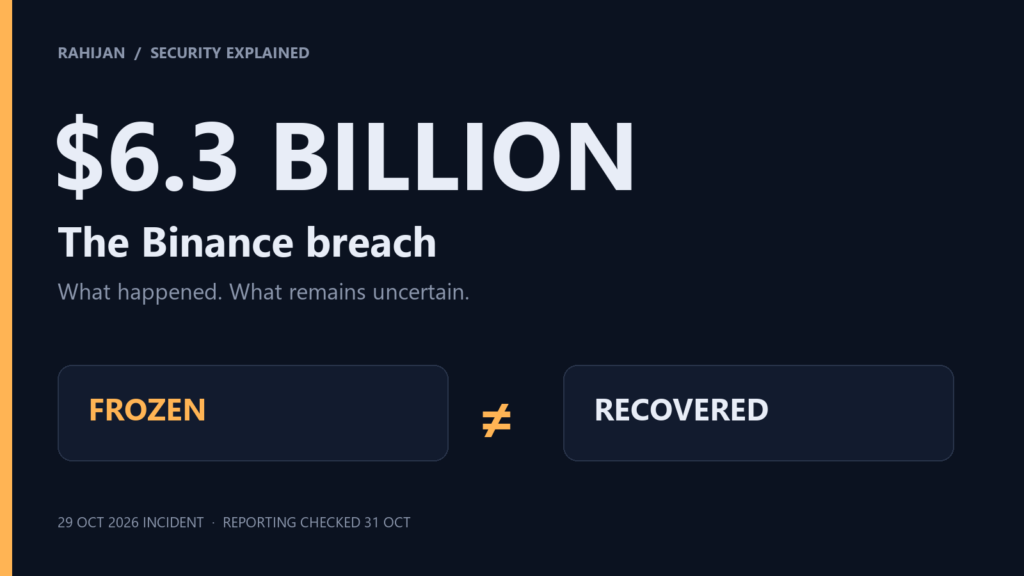
A huge theft. An initial lead involving a laptop. Then a race to stop stolen assets moving. The Binance breach is a developing investigation, so the distinction between a company statement, an analyst’s assessment and an established outcome matters.
Frozen funds are restricted from moving. Recovered funds have been brought back under legitimate control. Compensation is a separate commitment to make customers whole. These are three different things.
What happened?
Binance estimated the impact at about $6.3 billion. Blockchain investigator TRM Labs estimated approximately $6.36 billion in outflows across ten blockchains, valued at the time of each transfer. These are estimates with different valuation contexts, not a final audited loss figure. [1] [2]
A short, sourced timeline
- 28 October: TRM says on-chain preparation began at least 36 hours before the theft. This is its investigative assessment. [1]
- 29 October, from 20:05 UTC: Most of the theft occurred in roughly 20 minutes, according to TRM. It reports another wave around 23:05 UTC involving Avalanche and Polygon. [1]
- 30 October: Co-CEO Richard Teng said an initial investigation pointed to a compromised DevOps laptop, followed by access to a service container and unauthorized withdrawal transactions. He stressed that it was a complex process, not simply one employee’s permissions or one click. [2]
- Later reporting on 30 October: Binance said it had found additional breach points. The complete root cause remained under investigation. [3]
Why did stablecoins matter?
TRM reports that the attacker sold USDT and borrowed Ether against stolen USDT while issuers were freezing tokens. Its early snapshot counted roughly $2.7 billion frozen as of 00:30 UTC on 30 October. Binance subsequently reported approximately $3 billion frozen. Those figures describe different reporting snapshots. [1] [4]
Some stablecoins have issuer-controlled freezing powers. Ether has no equivalent token issuer freeze switch. That does not make it untraceable or rule out every intervention: TRM also describes emergency action by Arbitrum’s Security Council on its own network. [1]
What has Binance promised?
Binance said it would cover losses using its SAFU fund and company funds. The Block reported a $6.34 billion allocation, separate from frozen assets. That is the company’s stated funding commitment; it is not proof that every stolen asset has been recovered. [2] [4]
What remains unresolved?
Teng said Binance had not found evidence of a wallet private-key leak at that stage. TRM attributes the attack to North Korea’s TraderTraitor group with high confidence; this is the investigator’s attribution. The company had not named a responsible group in the reporting reviewed here. A final forensic account and the ultimate recovery total remain open questions. [2] [3]
Reporting checked on 31 October 2026. Figures and investigative conclusions may be revised. This article explains the incident; it does not claim that withdrawals have resumed or that frozen assets have already been returned.
Sources / References
- TRM Labs — on-chain investigation and timeline, 29 October; snapshot at 00:30 UTC, 30 October 2026.
- Richard Teng — Binance’s initial investigation statement, 30 October 2026.
- BleepingComputer — compromised laptop and wider breach reporting, 30 October 2026.
- The Block — Binance’s funding commitment and frozen assets, 30 October 2026.
Original Rahijan explainer. The accompanying video uses original motion graphics and an AI-generated English voice, with an original music bed.